The Gate That Outlived the House: Saving a Century of Ironwork From the Scrap Pile
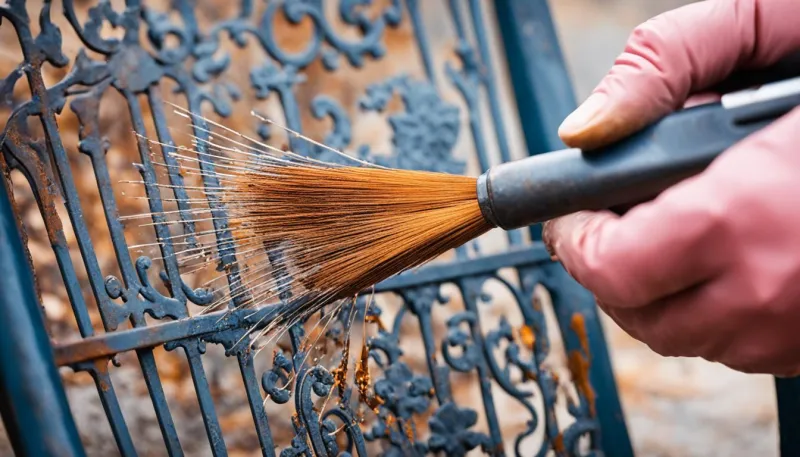
Photo: restoring antique wrought iron gate workshop rust removal, via wrought-iron-furniture.com
When Marcus Delgado inherited his grandmother's house outside Columbus, the wrought iron gate came with it — whether he wanted it or not. It had been leaning against the garage since the 1990s, half-buried in honeysuckle, its bottom rail furred with rust the color of an old brick. The first instinct, and honestly the reasonable one, was to haul it to the scrap yard and pocket the forty bucks.
Instead, he made a phone call. And that phone call is the reason the gate now hangs at the front of his own home, swinging on its original hinges, looking better than it probably has since the Eisenhower administration.
If you've inherited ironwork — a gate, a fence section, a garden bench that spent thirty winters under a tarp — here's what the rescue actually looks like.
First, the Verdict: Can It Be Saved?
The good news for sentimental homeowners: most old wrought iron is far tougher than it looks. Pre-1940s ironwork was typically made from puddled wrought iron, a material with a fibrous grain and remarkably low carbon content. It doesn't corrode the way modern mild steel does, and it resists rust in a way that surprises people who've only dealt with big-box store metal.
A smith or restoration fabricator will look for three things:
- Structural breaks, not surface rust. A crack at a scroll joint or a snapped picket is a repair. Flaking rust is just weather.
- Pitting depth. Some surface pitting is normal and even characterful. Deep, flaking metal that crumbles under a screwdriver is the real concern.
- Joinery. Riveted, collared, and forge-welded connections can almost always be preserved. Broken ones can often be re-forged rather than replaced with welds that scream "1990s repair."
In Marcus's case, the verdict came back easy: save it. One scroll had snapped, two pickets were missing, and the hinges were frozen solid — but the bones were sound.
What Restoration Actually Involves
This isn't a wire brush and a can of spray paint. A proper restoration of a piece like this runs through several distinct stages.
Documentation. Before a single tool touches the gate, the shop photographs and measures everything. If the piece has historical significance — and century-old residential ironwork sometimes does — this record matters.
Stripping and cleaning. Old paint, rust, and decades of grime come off, usually through a combination of controlled heat, mechanical cleaning, and sometimes gentle media blasting. The goal is bare, honest metal without erasing the hammer marks that make it worth saving.
Re-forging the losses. Here's where restoration becomes craft. The broken scroll wasn't welded back — it was re-forged from matching stock, heated in the forge, curled by hand, and collared into place the same way the original smith would have done it. The two missing pickets were drawn out to match the taper of their surviving siblings. Done right, you can't tell which parts are new.
Mechanical rehabilitation. Frozen hinges got disassembled, cleaned, re-fit, and lubricated. The latch mechanism — a lovely thumb latch with a worn brass catch — was freed up and adjusted so it actually latches again.
Finishing. Modern restorations usually skip the glossy black enamel in favor of a linseed-based paint or a wax-oil system that protects the metal while letting it breathe and age gracefully. The finish on Marcus's gate is matte, slightly uneven, and exactly right.
The Money Question
Here's the part that surprises people. A full professional restoration of a residential gate of this scale typically lands somewhere between $1,500 and $4,000 depending on condition and complexity. That sounds like a lot until you comparison shop.
A new, mass-produced iron gate from a big-box retailer runs $400 to $900 — and it's hollow-tube steel, machine-welded, powder-coated, and built to a lifespan measured in years, not generations. It will rust through at the welds within a decade or two and end up exactly where Marcus's gate almost went.
The restored gate, meanwhile, is now arguably the best-made object on his property. It was forged by hand from material that outlasted the house it was built for. With basic annual maintenance — a wash, an inspection, a touch of wax — it will outlast him, and whoever gets the house after him.
Cost per year of service? You do the math. It's the cheapest fine metalwork in America.
Why It's Worth the Call
There's a practical argument and there's the other one. The practical argument: quality, longevity, and the fact that old wrought iron genuinely is a superior material to most of what's fabricated today.
The other argument is harder to price. When Marcus's daughter asks about the gate, he can tell her about her great-grandmother's house on the east side, the garden it once guarded, and the smith who re-forged a broken scroll in 2024 so the story could keep going. No catalog purchase comes with that.
So before you drag that rusted fence section or frozen garden bench to the curb, take an hour and find a local smith or restoration shop. Most will look at photos for free and tell you honestly whether a piece is worth saving. Some will even tell you when it isn't — which is its own kind of trustworthiness.
Grandma's ironwork survived a century of neglect. It can survive the trip to a forge.