From Coffee-Stained Sketch to Statement Piece: The Secret Life of One Commission
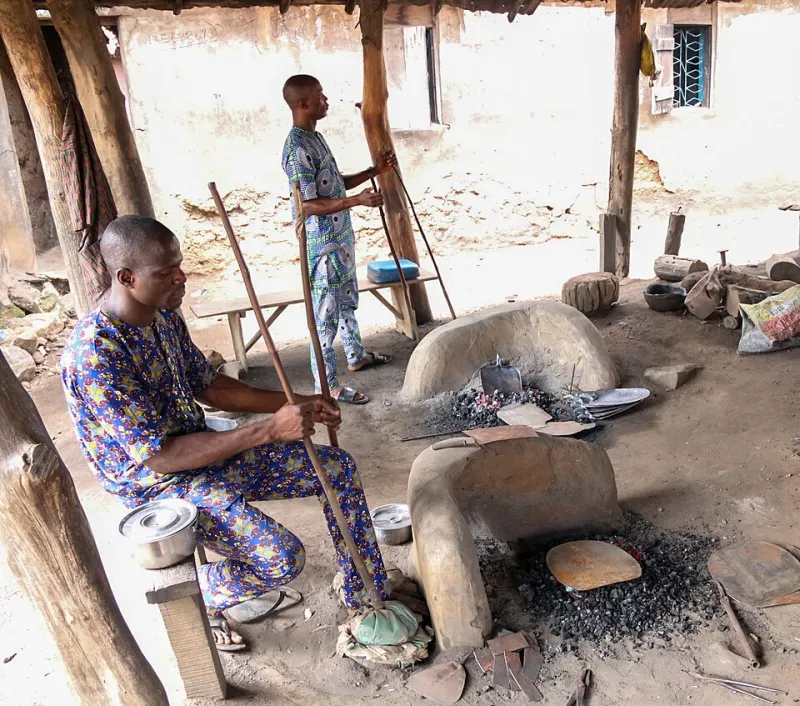
Photo: Agbalagba, CC BY-SA 4.0, via Wikimedia Commons
It started, as a surprising number of great pieces do, over breakfast.
A couple from Asheville sat in a diner outside Black Mountain, sketching on the back of a paper placemat. They'd just closed on a 1920s craftsman with fourteen-foot ceilings in the dining room — a gorgeous space that swallowed every off-the-shelf light fixture they tried. The husband drew a loose, branching form. The wife added a note: like the oak in the side yard, but indoors.
Six months later, that napkin sketch hung twelve feet above their dining table as a hand-forged chandelier. Here's how it got there.
The Sketch Doesn't Have to Be Good — It Has to Be Honest
The first thing to know about commissioning metalwork is that nobody expects you to draw. The napkin went into an email, crooked lines and coffee ring included, and that was enough. What a smith reads in a rough sketch isn't geometry — it's intent. The branching shape said organic, not ornate. The note about the oak said this piece should mean something specific to us.
From there came a conversation. The smith asked questions the couple hadn't thought of: How low could the fixture hang before it blocked sightlines? Did they want the metal bright and polished, or dark and quiet? Would this room host big holiday dinners or quiet weeknight meals?
The answers shaped everything that followed. Which is the point — the design phase is where a commission either becomes personal or becomes just another pretty object.
Choosing the Metal Is Choosing the Personality
Steel, bronze, copper, iron — each behaves differently under the hammer and ages differently on the wall (or in this case, the ceiling).
For this piece, the smith suggested mild steel for the main branches, forged at working heat so the tapering forms could keep their fluid, hand-drawn quality. But the leaves — small, hammered elements scattered along the branches — would be copper, torch-colored to shades of amber and violet.
Why mix? Steel gives structure and heft; copper gives warmth and light play. Under the glow of the bulbs, the copper leaves would read like autumn catching fire. For a dining room in a craftsman home, that palette made sense before anyone said a word about it.
Joinery: The Part You'll Never See and Always Feel
Here's a detail most homeowners never think about: how the pieces connect.
There are two ways to join metal. You can weld it — fast, strong, invisible. Or you can use traditional joinery: collars, wraps, rivets, tenons drawn out and drifted through. The second way takes longer. It also leaves visible evidence of the hand, little functional details that reward a closer look.
The couple chose traditional joinery, and the smith shaped each copper leaf around a hand-forged rivet, the way a blacksmith a century ago would have held a gate hinge together. Look up from the right angle and you can see every one. That's not a flaw. That's the signature.
The Mockup Nobody Expects to Fall in Love With
Before a single full-size branch was forged, the shop built a rough cardboard-and-wire mockup at full scale and hung it from the studio rafters. The couple came in to see it, which we recommend for every commission that involves something overhead.
Standing under it changed the design. The original sketch had three main branches; in the room's proportions, three felt sparse. Four — asymmetric, weighted toward the long side of the table — felt right. Better to discover that in cardboard than in steel.
Fire, Hammer, Repeat
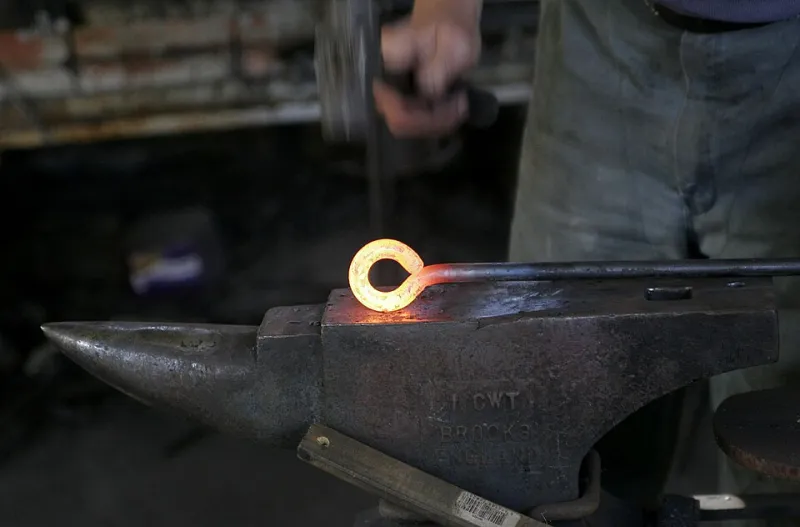
The forging itself took about five weeks. Each steel branch started as straight bar stock, heated to a glowing orange in the forge, then drawn out under repeated hammer blows — thinner and thinner toward the tips, so the whole piece tapers the way a real limb does.
No two tapers came out identical. That's not a bug in the process; it's the whole reason to forge something by hand. A machine can bend metal into a branch shape. Only a hammer, guided by a person who's done it thousands of times, makes metal feel grown.
Finishing: Deciding How It Ages
The last creative decision was the finish. The couple could have gone with a sealed bright steel. Instead, they chose a hand-rubbed dark patina with subtle highlights buffed along the branch tops — a finish that will soften and warm over the years rather than stay frozen in time.
A good finish isn't a coat of paint. It's a prediction about how the piece should look in twenty years. Choose well, and the patina becomes part of the story.
Installation Day
The chandelier went up on a gray Tuesday in October, rigged to a reinforced ceiling plate the couple's electrician installed in advance. When the bulbs came on — warm LEDs hidden inside copper leaf shades — nobody in the room talked about the light fixture. They talked about the oak tree in the side yard.
That's the test, honestly. When a finished commission makes people talk about something other than the object itself, you've forged a piece that belongs exactly where it is.
Your Napkin Moment
You don't need a fourteen-foot ceiling or a family oak. You need one honest idea, scribbled badly, and a smith willing to ask the right questions. The magic isn't in the fire — it's in everything you and your smith decide before the first bar ever heats up.
So the next time inspiration strikes over breakfast, grab the napkin. We've worked with worse.