Six Weeks Isn't a Delay — It's the Process: A Realistic Timeline for Custom Metalwork
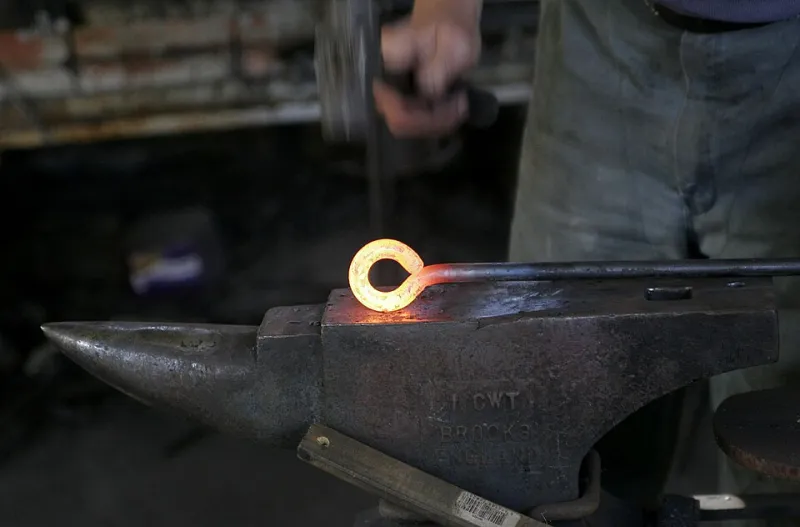
Photo: User:Fir0002, GFDL 1.2, via Wikimedia Commons
Somewhere between your first email and the moment a forged piece arrives at your door, there's a stretch of quiet — usually four to eight weeks — where it can feel like nothing is happening. It is. Plenty is happening. You just can't see it from the outside.
At Artizan Metal, we'd rather walk you through that stretch than have you spend it wondering. So here's what those weeks actually look like, why the timeline is what it is, and — most usefully — when you should place your order so your piece shows up exactly when you need it.
Week One: The Conversation and the Drawing
Before a single bar of steel gets heated, there's design work. We'll talk through where the piece will live, what it needs to do (a railing has to meet code; a fire feature has to handle heat; a sculpture mostly has to be loved), and what your space is telling us about scale and finish.
Then comes a drawing or rendering. For something simple — a set of cabinet pulls, a small wall piece — this might take a day or two. For a stair railing with curves, a gate with custom geometry, or a statement chandelier, expect a week of back-and-forth. Revisions here are cheap. Revisions after cutting are not. This is the week to be decisive.
Weeks Two and Three: Sourcing and Layout
Once you approve a design, materials get ordered and the layout gets worked out. Raw stock — steel, brass, copper, whatever the piece calls for — has to match the design, and specialty sizes or finishes sometimes take a week or more to arrive from the mill or supplier.
This is also when the smith maps the build: how each element bends, where the joinery lands, how the whole thing comes together. It's unglamorous work, and it's exactly why handcrafted pieces fit the way they do. A machine doesn't think about how a curve meets a post. A person does.
Weeks Three Through Five: Fire, Hammer, and Welds
This is the part people imagine, and honestly, it's the best part. Hot forging, bending, cutting, and joining happen here — often in bursts, because metalwork is a start-and-stop craft. A piece gets heated, shaped, and then has to rest while the next element is worked. Welds get laid, ground, and dressed. Every component gets checked against the drawing and, more importantly, against the other components. A railing built in pieces still has to become one piece.
For most commissions, this fabrication window is one to three weeks depending on complexity. A sculptural piece with dozens of forged leaves will take longer than a clean-lined modern frame. That's not padding — that's the physics of doing it by hand.
The Final Week: Finishing, Which Is Half the Job
Ask any smith and they'll tell you: finishing takes as long as you'd never guess. Welds get cleaned. Surfaces get brushed, polished, or textured. Then the protective work begins — patinas applied and sealed, powder coat cured, wax or clear coat layered on and given time to set.
Rushing finishing is the number one way a beautiful piece gets ruined. A sealer applied to warm metal, a patina rushed before it stabilizes, a powder coat cured too fast — these are the shortcuts that show up a year later as peeling or blotching. We don't take them, which is why the last stretch of the timeline matters as much as the forge work.
Why Rushing Costs Quality
There's an old shop saying: you can have it fast, or you can have it right, and the second one is the only one worth hanging on your wall. Compressed timelines force compromises somewhere — thinner stock that's quicker to work, simpler joinery, a finish applied before it's ready. None of those show up in a photo. All of them show up in ten years.
The good news: you rarely need to rush. You need to plan.
How to Order at the Right Moment
A little calendar math saves a lot of disappointment.
For holiday gifts: Order by early October. A custom piece needed by mid-December should be in the shop's queue no later than the first week of that month — earlier if it's complex. Remember that November and December are the busiest season for most American metal shops, and queues fill in the order they're received.
For a renovation or new build: Talk to the smith when the construction timeline is set, not after the drywall goes up. Railings and gates need accurate field measurements, and those are easiest to capture at the right stage. Build in the full six to eight weeks plus a buffer for the contractor's schedule.
For weddings, anniversaries, and milestones: Give it two months minimum. Custom pieces made to mark a date benefit from the extra breathing room — and from the smith knowing the story behind the commission.
For spring and summer outdoor pieces: Order in late winter. Fire pits, planters, and patio pieces fabricated in February and March are ready the moment your weather turns. Ordering in May means you might spend half the season waiting.
The Wait Is Part of What You're Buying
There's a reason handmade furniture, forged knives, and custom metalwork all carry the same reputation for longevity: the time is baked in. Every week in that six-week window is doing a specific job — refining the design, matching the material, shaping the metal, protecting the surface.
When your piece arrives and you run a hand along it, you're feeling all of it: the conversation, the drawing, the heat, the patience. Plan for the wait, and it stops being a wait. It becomes the countdown to something that was made, not manufactured.