Lift It, Listen to It, Look Closely: How to Spot the Real Thing in Handcrafted Metal

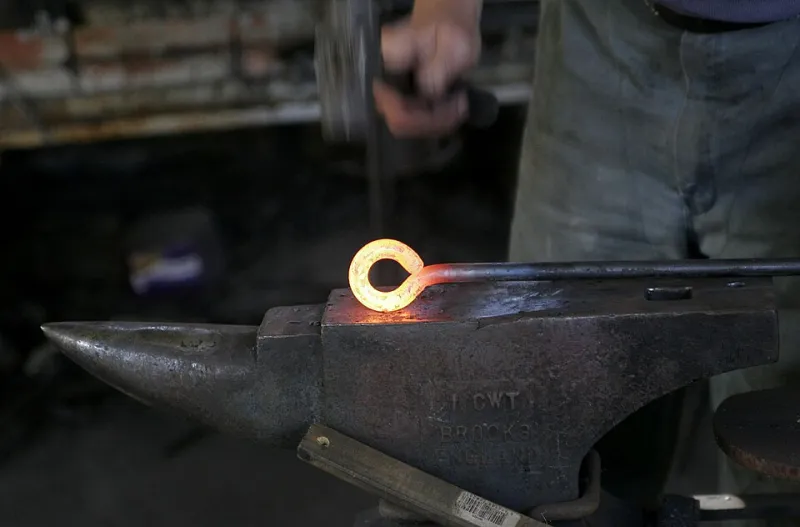
Photo: Unknown, Public domain, via Wikimedia Commons
There's a moment that happens at almost every craft fair we attend. A shopper picks up a forged bottle opener, turns it over, feels the weight of it in their palm, and their eyebrows go up. They didn't expect it to feel like that.
That reaction is the whole point. Handmade metal announces itself the moment you interact with it — and once you know what to look and listen for, you'll never mistake it for the stamped, cast, and chrome-plated stuff filling big-box shelves.
Start With the Pick-Up Test
Weight is the fastest tell. Genuine handcrafted pieces are usually made from solid stock — forged steel, solid brass, thick copper — because that's what a smith can actually work with. Mass-market imitations lean on hollow tubing, thin stamped sheet, or pot metal to cut costs.
A hand-forged hook should feel substantial, maybe surprisingly so. A hollow replica feels like exactly what it is: a shell. If a seller claims something is "solid forged iron" and it weighs about as much as a paperback novel, you have your answer.
Give It a Knock
This one feels odd the first time you do it in public, but it works. Tap the piece gently with a knuckle.
Solid metal answers with a dense, muted thunk. Hollow or thin-gauge material rings — a high, tinny vibration that carries. Sculptors and metalworkers do this instinctively, the way a cook taps a melon. It's not superstition; it's physics. Density changes how sound travels, and there's no way to fake it with a coating.
Read the Surface Like a Story
Every method of making leaves a fingerprint, and handmade metalwork leaves the maker's literally.
Hammer marks. Look for subtle, irregular faceting across the surface — slight peaks and valleys that catch light differently as you turn the piece. Machine-made items have uniform texture or none at all. A light coat of wax or oil on a forged piece often makes these marks easier to see.
Welds. A production weld is a smooth, identical bead repeated a thousand times a day. A fabricator working one-off commissions welds by hand, and it shows: slight variation in bead width, occasional small ripples, grind marks where they cleaned up a joint. On rustic or organic work, those welds are often left deliberately visible — not sloppiness, just honesty about how the piece came together.
Asymmetry. Two hand-forged scroll ends will never be perfect twins. If a "handmade" bracket has scrolls so identical they could be mirror images, they probably were — by a machine.
Where You Shop Changes the Odds
Craft fairs and maker markets. Your best odds by far. You can pick everything up, and the person behind the table made it or knows the person who did. Ask them to describe their process — real makers light up and get specific fast.
Galleries. Reputable craft galleries and juried shows vet their artists, so the curation work is done for you. Expect gallery pricing, but also provenance and often a maker's card.
Online marketplaces. The trickiest terrain. The phrase "hand forged" gets slapped on imported cast reproductions constantly. Look for process photos, workshop shots, maker names you can look up, and American studio locations. If a listing offers fifty "hand forged" drawer pulls shipping in bulk from overseas, the forge is fictional.
Five Questions to Ask Before You Buy
- Who made this, and where? A name and a shop location should come easily.
- What's the material? "Iron-look steel" or vague "metal alloy" answers deserve follow-up. Solid steel, wrought iron, brass, and copper should be stated plainly.
- Is it solid or hollow? Perfectly reasonable, and any honest seller will say so.
- How was it finished? Forged and waxed, powder coated, hot-dip galvanized, natural patina — the finish tells you how it'll age and where it can live.
- Can it be repaired or refinished? Handmade pieces generally can. Welded-on stamped imports usually can't.
Why It's Worth the Effort
A handcrafted piece costs more up front, no getting around it. But you're buying something that won't chip and reveal gray pot metal underneath in two years, something that can be re-welded, re-waxed, and handed down. The weight in your hand at that craft fair table? That's not just steel. It's the difference between decor you'll replace and a piece you'll keep.
Pick it up. Knock on it. Look close. The real thing always tells you.