Your Entryway Is a First Impression — Here's How to Make It in Metal
Think about the last home that genuinely wowed you. Odds are, the magic started before you even took off your coat. The entryway is your home's opening line, and most of us are mumbling ours. A thoughtfully placed piece of metalwork changes that instantly — it catches light, draws the eye, and quietly says someone with taste lives here.
Here are seven ways to pull it off, no matter your square footage.
1. A Large-Scale Wall Hanging
Nothing transforms a blank entryway wall faster than a sculptural metal wall piece. Go big: a piece spanning 36 to 48 inches reads as intentional, while something too small just looks like an afterthought.
Placement tip: Center it at eye level, around 57 to 60 inches from the floor. If your entryway is narrow, choose a piece with depth and dimension — layered steel or woven metal catches light differently as you walk past.
Lighting: A picture light mounted above, or a ceiling-mounted accent light angled at 30 degrees, will make those textures pop in the evening.
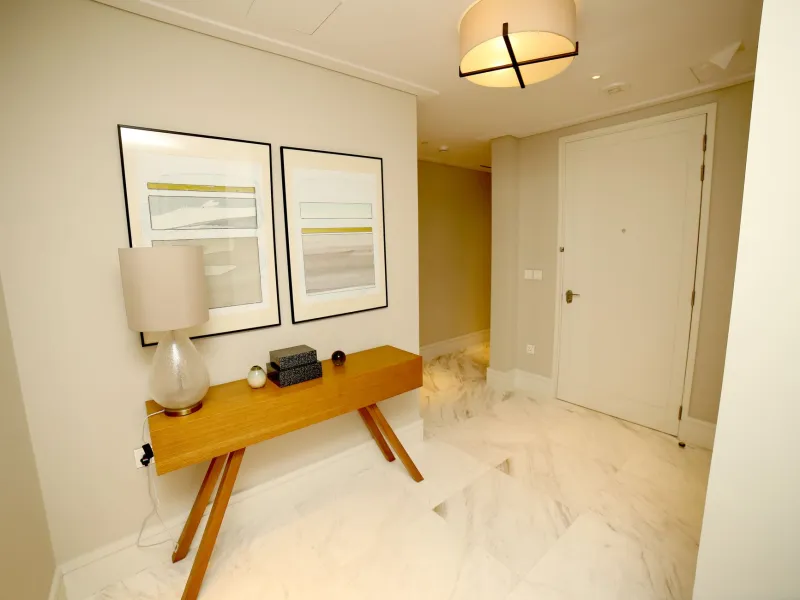
2. A Console Table with a Sculptural Metal Base
The console is the workhorse of entryway furniture, but the base is where you can have fun. A hand-forged steel base — think branching forms, geometric frames, or a hammered organic shape — turns a functional piece into the room's anchor.
Scale guidance: In a compact entry, keep the console under 48 inches wide with slim legs so sightlines stay open. Larger foyers can handle a 60-inch statement with a bolder silhouette.
Lighting: A table lamp on top gives you a warm glow and doubles the visual impact of that base after dark.
3. A Custom Stair Railing (Yes, Really)
If your entryway opens onto a staircase, your railing is prime real estate. Most builder-grade railings are forgettable tubes. A custom railing — twisted balusters, a laser-cut panel with a botanical or geometric pattern — turns code-required safety equipment into art you touch every day.
Placement tip: This one's fixed, so focus on finish. A warm bronze or oil-rubbed patina pairs beautifully with white oak stairs; raw black steel suits modern and industrial interiors.
Lighting: Recessed step lights or a sconce on the stairwall will rake light across the railing's details.
4. A Freestanding Floor Sculpture
Got a corner near the door that's collecting dust? A freestanding metal sculpture — abstract, figurative, or somewhere in between — fills dead space with personality.
Scale guidance: Follow the rule of thirds: the sculpture should be roughly one-third to one-half the height of the ceiling in a two-story foyer, or 24 to 40 inches in a standard 8-foot entry.
Lighting: These pieces beg for an uplight. A small can light or a plug-in uplight behind the base creates dramatic shadows on the wall behind.
5. An Oversized Metal Mirror Frame
Every entryway needs a mirror — for last-minute checks and for bouncing light in what's often the darkest room of the house. Frame it in hand-hammered or patinated metal and it does double duty as decor.
Placement tip: Opposite a window if you can; the mirror will pull natural light deep into the space. In tight entries, a tall narrow mirror (say 24 by 60 inches) adds height without bulk.
6. A Metal Coat Rack That Earns Its Keep
Function first, but make it beautiful. A forged coat rack — whether wall-mounted with branch-like hooks or a freestanding hall tree with a iron base — handles the daily drop zone without looking like a mudroom afterthought.
Placement tip: Keep it within arm's reach of the door, but give it breathing room so coats don't swallow the piece visually. Mount wall versions at 66 to 68 inches so long coats clear the floor.
7. A Statement Ceiling Piece or Pendant
Look up. In a two-story foyer or an entry with decent ceiling height, a metal pendant or chandelier — hand-forged arms, a hammered shade, a patinated frame — sets the tone from the moment someone steps inside.
Scale guidance: In a standard 8-foot entry, keep the fixture under 20 inches tall and hang it at least 7 feet off the floor. Double-height foyers can go dramatic: a 36-inch-plus fixture, centered in the stairwell's open space.
Lighting: Put it on a dimmer. Warm light (2700K) through a metal shade casts gorgeous patterned shadows.
Pulling It Together
You don't need all seven — honestly, one or two done well beats five done halfway. Pick the piece that fits your space's biggest gap, get the scale right, and give it light to work with. Handcrafted metal has a way of making an entryway feel considered, and that's a first impression worth investing in.